
The Enterprise Paradox: Preserving Purpose While Preparing for What Comes Next
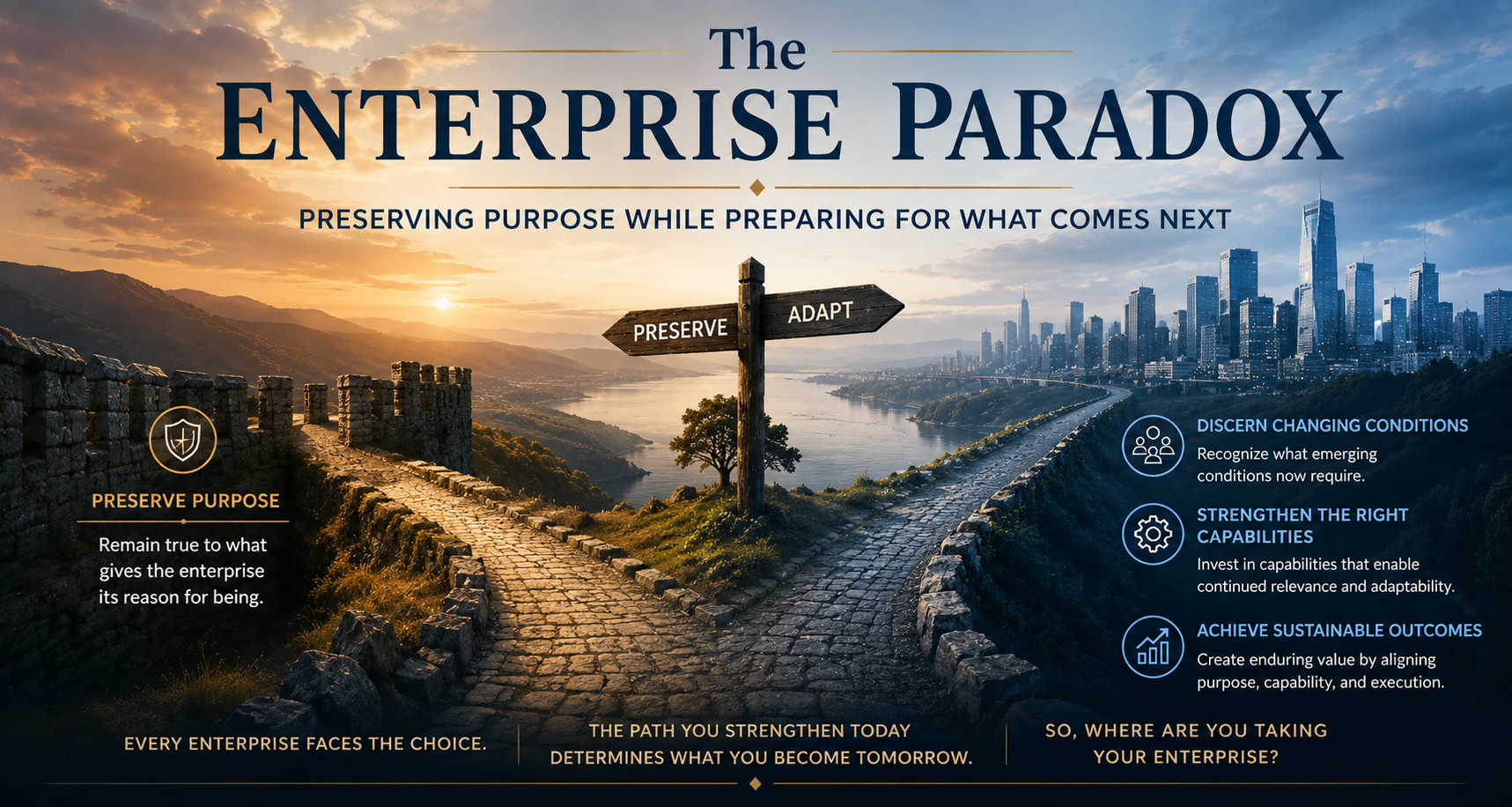
Enterprises rarely lose their way because they lack capability.
Many become remarkably capable. They modernize technology, remap business processes, enhance operations, and invest in innovation. By every conventional measure, the enterprise appears stronger than ever.
Some enterprises continue thriving through successive waves of technological, economic, regulatory, and societal change. Others quietly become less capable of adapting despite continuing to strengthen the very capabilities that once made them successful.
Perhaps the question is not whether enterprises know how to build capability.
Perhaps the more important question is whether they continually strengthen the capabilities that changing conditions now require.
Every Enterprise Exists to Fulfill a Purpose.
That purpose may take many forms: creating meaningful value, introducing competitive products or services, advancing knowledge, strengthening sustainability, or improving communities.
Regardless of industry sector, every enduring enterprise exists because it seeks to realize a purpose greater than the activities it performs each day.
As enterprises grow, markets shift, societal expectations change, technology evolves, functions expand, and decisions become delegated.
The enterprise does not intentionally undermine its purpose. It gradually accumulates interpretation.
Interpretation is inevitable. Drift is not.
Capability Alone Does Not Ensure Enterprise Continuity
Capability is essential. Yet capability alone cannot explain why enterprises facing similar conditions experience profoundly different outcomes.
Some enterprises continually renew themselves by strengthening the capabilities that emerging conditions require.
Others continue strengthening the enterprise—yet not the capabilities that emerging conditions require.
This is not a failure of capability. It is the failure to continually recognize which capabilities deserve to be strengthened.
The Enterprise Paradox
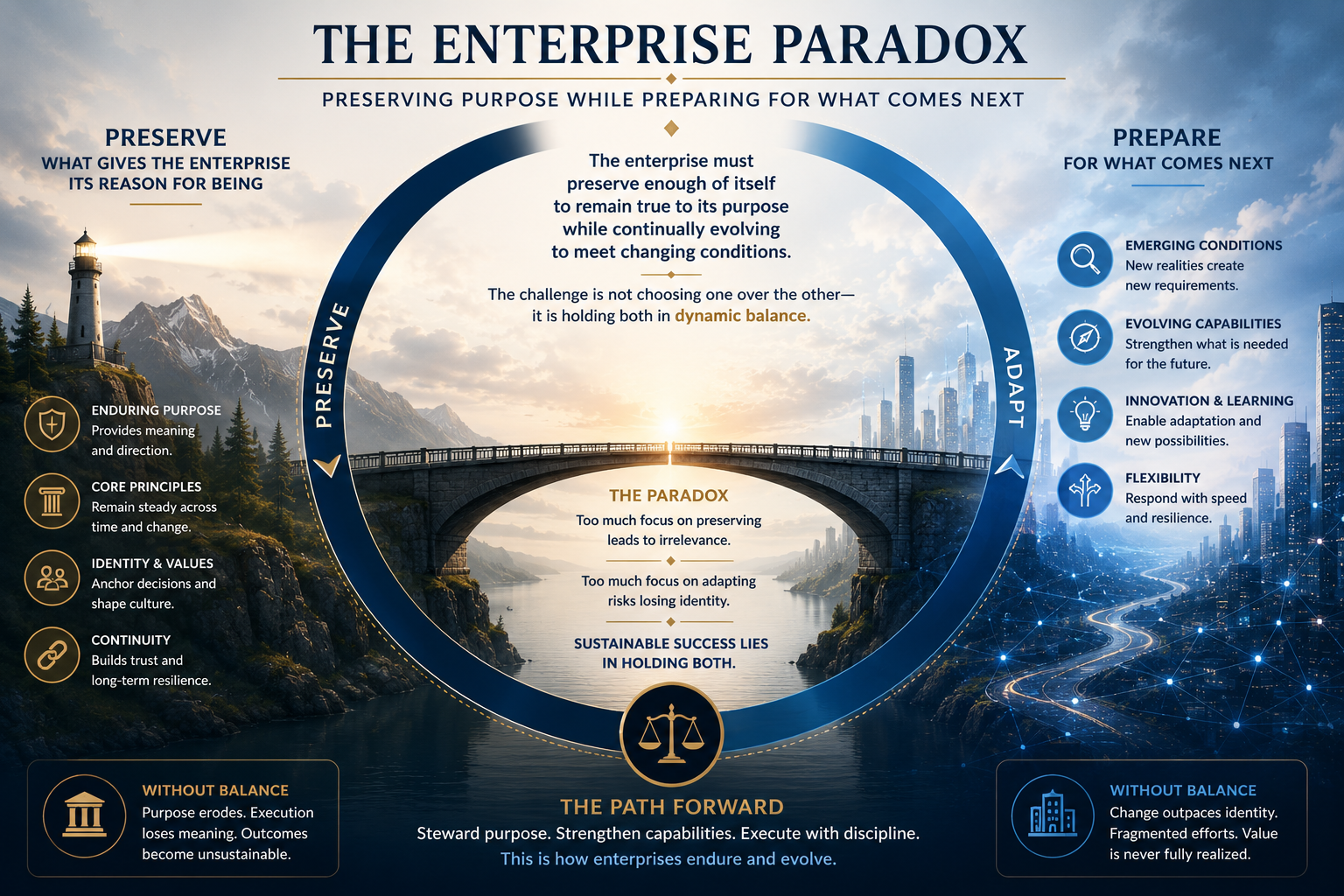
Every enterprise must preserve enough of itself to remain true to its purpose.
Every enterprise must also change enough of itself to remain capable of fulfilling that purpose.
If preservation dominates, the enterprise gradually becomes exceptionally well prepared for conditions that no longer exist.
If adaptation dominates without continual stewardship of enterprise purpose, the enterprise gradually loses coherence between what it seeks to become and why it exists.
Both paths appear reasonable. Neither can sustain the enterprise alone.
This is the Enterprise Paradox.
The Quiet Drift
This paradox rarely appears at once. It emerges one decision, one investment, and one capability at a time.
Every decision appears reasonable in isolation. Collectively, however, those decisions begin shaping what the enterprise is becoming.
Perhaps the greatest enterprise risk is not change itself.
Perhaps the greater risk is quietly becoming increasingly capable of preserving yesterday.
A Different Question
Enterprises naturally ask: What should we improve next?
Perhaps there is a more fundamental question:
What are we continually becoming?
That question cannot be answered by another policy, another committee, or another transformation initiative.
It requires something deeper.
A Mirror for Enterprise Leaders
Before introducing another capability...
Before refining another operating model...
Pause.
What have we actually built?
Has the enterprise become more capable... or simply more structured?
What are we continually becoming?