
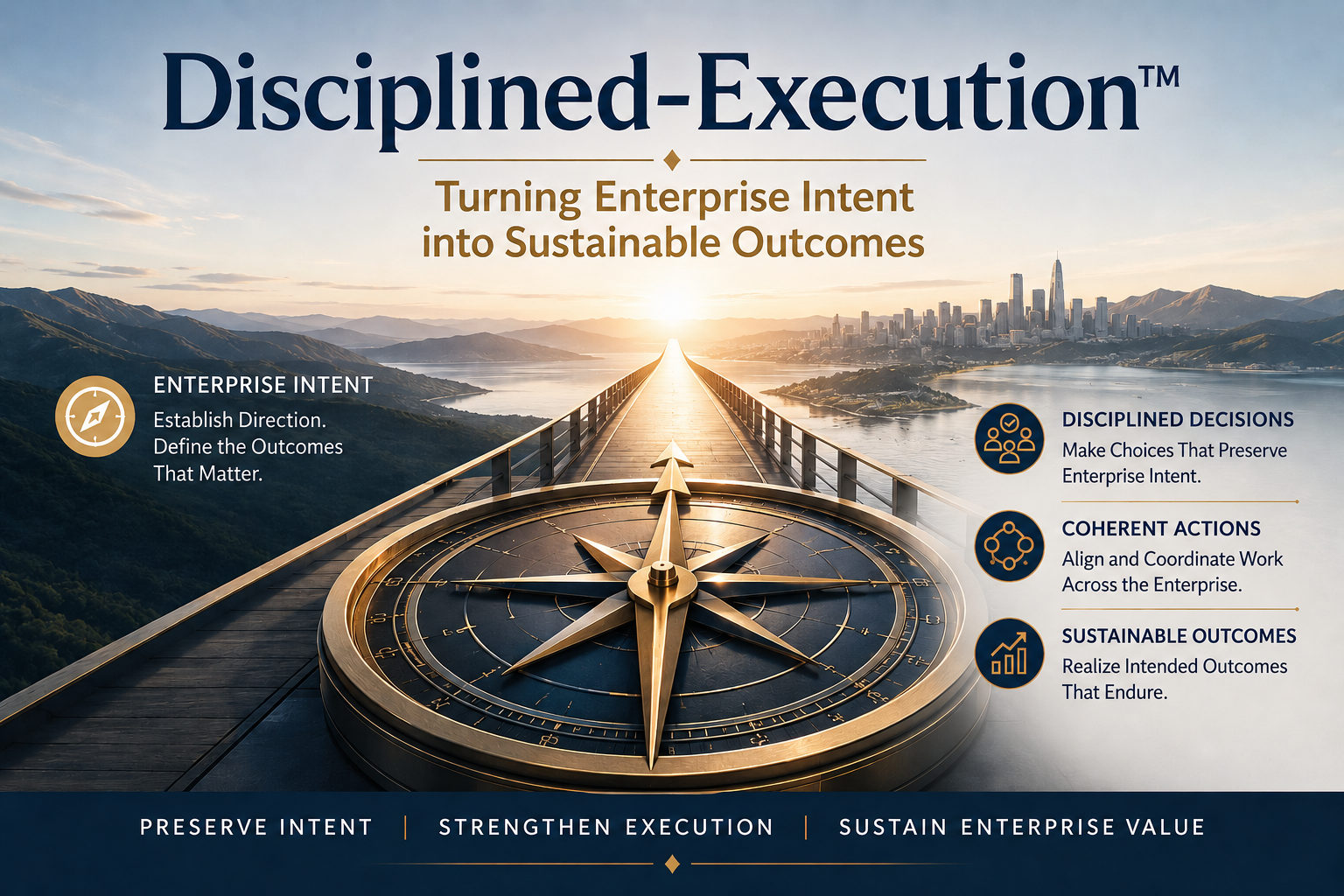
Disciplined-Execution™: Turning Enterprise Intent into Sustainable Outcomes
Enterprises rarely struggle because people are unable to execute.
In fact, many enterprises execute remarkably well.
Projects are delivered.
Programs achieve their milestones.
Teams remain productive.
Governance appears effective.
Dashboards indicate progress.
By every conventional measure, execution appears successful.
Yet enterprise leaders continue to ask the same question.
Why are we executing so much work without realizing the enterprise outcomes we intended?
Perhaps the question is not whether enterprises know how to execute.
Perhaps the question is whether we have misunderstood what execution is meant to preserve.
Could enterprises be becoming increasingly proficient at executing work while becoming progressively less effective at preserving enterprise intent?
In the previous Insight, Why Practices Fail When Enterprise Principles Are Missing, we explored how practices lose their purpose when they become detached from the Enterprise Principles that gave rise to them.
Enterprise Principles establish direction.
Principled-Practices™ translate those principles into coherent ways of working.
However, principles and practices alone do not produce enterprise outcomes.
They become meaningful only when they are consistently translated into execution.
That is where Disciplined-Execution™ begins.
The Illusion of Execution Success
Perhaps the greatest misconception about execution is that successful delivery naturally leads to enterprise success.
Projects succeed.
Programs deliver.
Teams perform.
Dashboards remain green.
Stakeholders express satisfaction.
Execution appears healthy.
Yet enterprise leaders continue asking why intended outcomes remain frustratingly out of reach.
Enterprises often mistake successful execution for preserved enterprise intent.
Successful delivery demonstrates that work was completed.
It does not necessarily demonstrate that enterprise intent remained intact throughout execution.
Viewed through that distinction, enterprises begin asking different questions about execution.
Is Execution About Delivering Work?
Execution is traditionally described in operational terms.
Delivering projects.
Meeting milestones.
Managing resources.
Completing scope.
Achieving schedule commitments.
These measures matter. But they invite a more fundamental question.
What if execution has never been about delivering work?
What if execution is really about preserving enterprise intent while work is being delivered?
Enterprises can execute efficiently while unintentionally drifting away from the very outcomes they intended to achieve.
Successful delivery does not necessarily translate into enterprise success if the countless decisions made throughout execution gradually disconnect activities from the enterprise purpose they were meant to serve.
Disciplined-Execution™ therefore extends well beyond delivery management.
Its purpose is to preserve the integrity of enterprise intent as work progresses across increasingly complex enterprise environments.
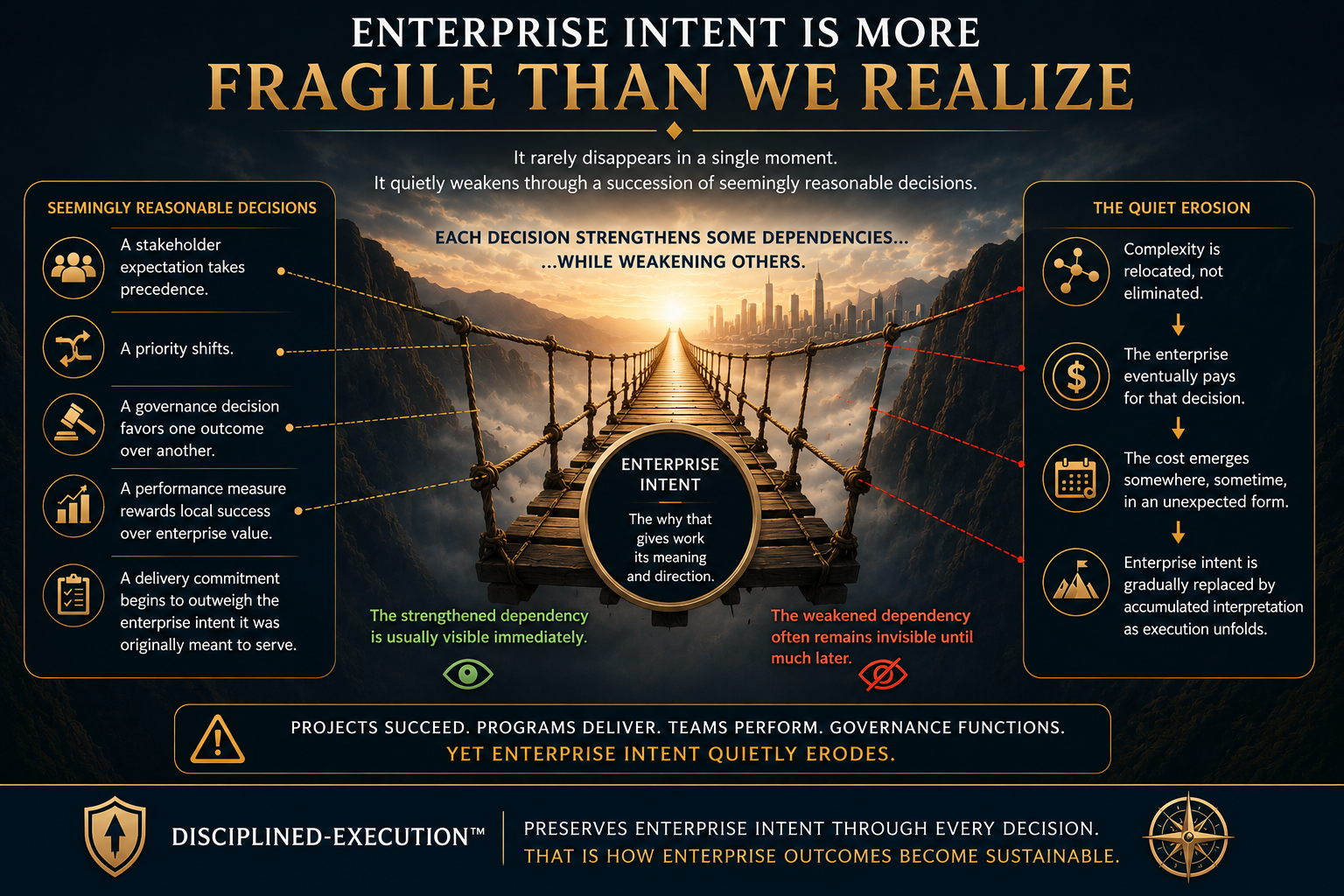
Enterprise Intent Is More Fragile Than We Realize
Enterprise intent rarely disappears because of a single decision.
It quietly weakens through a succession of decisions that, viewed individually, appear entirely reasonable.
That is precisely what makes it difficult to recognize.
A stakeholder expectation takes precedence.
A priority shifts.
A governance decision favors one outcome over another.
A performance measure rewards local success over enterprise value.
A delivery commitment begins to outweigh the enterprise intent it was originally meant to serve.
None of these decisions appear significant in isolation.
Why?
Because every enterprise operates through an intricate network of interconnected dependencies.
Every significant decision strengthens some of those relationships.
Every significant decision also has the potential to weaken others.
The strengthened dependency is usually visible immediately.
The weakened dependency often remains invisible until much later.
Strengthening one dependency while weakening another rarely strengthens the enterprise as a whole. It simply relocates complexity.
The enterprise eventually pays for that decision.
The only uncertainty is where, when, and in what form the cost becomes visible.
Collectively, these seemingly reasonable decisions reshape execution.
Projects succeed.
Programs deliver.
Teams perform.
Governance functions.
Yet enterprise intent has gradually been replaced by accumulated interpretation as execution unfolds.
Perhaps the greatest execution risk is not poor delivery.
It is the quiet erosion of enterprise intent through thousands of well-intentioned decisions.
A Different Way of Thinking About Execution
Most enterprises ask:
“Are we executing according to plan?”
Viewed through this perspective, enterprises begin asking a different question.
“Are today’s decisions preserving the enterprise intent the plan was created to realize?”
That single question changes the meaning of execution. Execution is no longer viewed simply as completing work.
Execution becomes the enterprise capability through which enterprise intent is preserved while work is continuously interpreted, delegated, coordinated, adapted, and delivered.
Perhaps execution has never been the capability of delivering work.
Perhaps execution has always been the capability of preserving enterprise intent while work continuously evolves.
Viewed through that lens…
Disciplined-Execution™ is the enterprise capability of consistently translating enterprise intent into coordinated decisions, coherent actions, and sustainable outcomes while adapting responsibly to changing operating conditions.
It is not a standalone practice, methodology, governance function, or operational discipline.
It is an enterprise capability that strengthens the continuity of enterprise intent across every execution context.
Its purpose is not to constrain adaptation.
Its purpose is to ensure that adaptation never loses sight of enterprise intent.
Does Discipline Limit Adaptation?
Discipline is frequently misunderstood as rigidity.
But does the absence of discipline actually make enterprises more adaptable?
Or does it simply make enterprise behavior increasingly unpredictable?
Without shared Enterprise Principles guiding execution, every change becomes open to interpretation.
Every adjustment introduces another variation.
Every localized optimization has the potential to weaken an interconnected dependency elsewhere within the enterprise.
Disciplined-Execution™ strengthens the conditions under which decentralized decisions remain anchored to enterprise intent rather than individual interpretation.
When discipline is grounded in principles instead of procedures alone, enterprises gain something far more valuable than consistency.
They gain coherent adaptability.
Are We Measuring Activity or Enterprise Progress?
Enterprises naturally measure activity.
Projects completed.
Milestones achieved.
Resources utilized.
Features delivered.
Budgets consumed.
These indicators describe movement.
They do not necessarily demonstrate enterprise progress.
Perhaps a more important question is this.
Are we measuring how much work is being completed…
…or how effectively enterprise intent is being preserved?
Progress occurs only when execution continues to strengthen the enterprise purpose for which the work exists.
When today’s decisions no longer reinforce that purpose, additional activity merely accelerates misalignment.
Disciplined-Execution™ therefore encourages continual recalibration—not because execution has failed, but because enterprise intent deserves continual protection.
Sustainable Outcomes Require Execution Continuity
Execution is often viewed as the final stage of delivery.
Enterprise value suggests otherwise.
Value emerges when delivered capabilities become adopted, operationally integrated, continuously improved, and strengthened over time.
Disciplined-Execution™ preserves execution continuity by helping enterprises maintain the integrity of enterprise intent throughout adoption, operational integration, capability development, organizational learning, and continuous improvement.
Execution is not complete when work is delivered.
Execution is complete when enterprise intent has become sustainable enterprise capability.
Closing Perspective
Perhaps the greatest execution challenge facing today’s enterprises is not learning how to execute.
It is learning how to preserve enterprise intent while execution continuously evolves.
Enterprise intent establishes direction and guidance.
Enterprise Principles preserve purpose.
Principled-Practices™ translate purpose into coherent ways of working.
Disciplined-Execution™ preserves the integrity of enterprise intent throughout execution.
Enterprise intent is not preserved because execution begins well.
It is preserved because every decision made thereafter continues to strengthen the conditions that allow enterprises to realize it.
Perhaps the more important question is not whether enterprises execute with discipline—but how that discipline is continually sustained as enterprises evolve.