
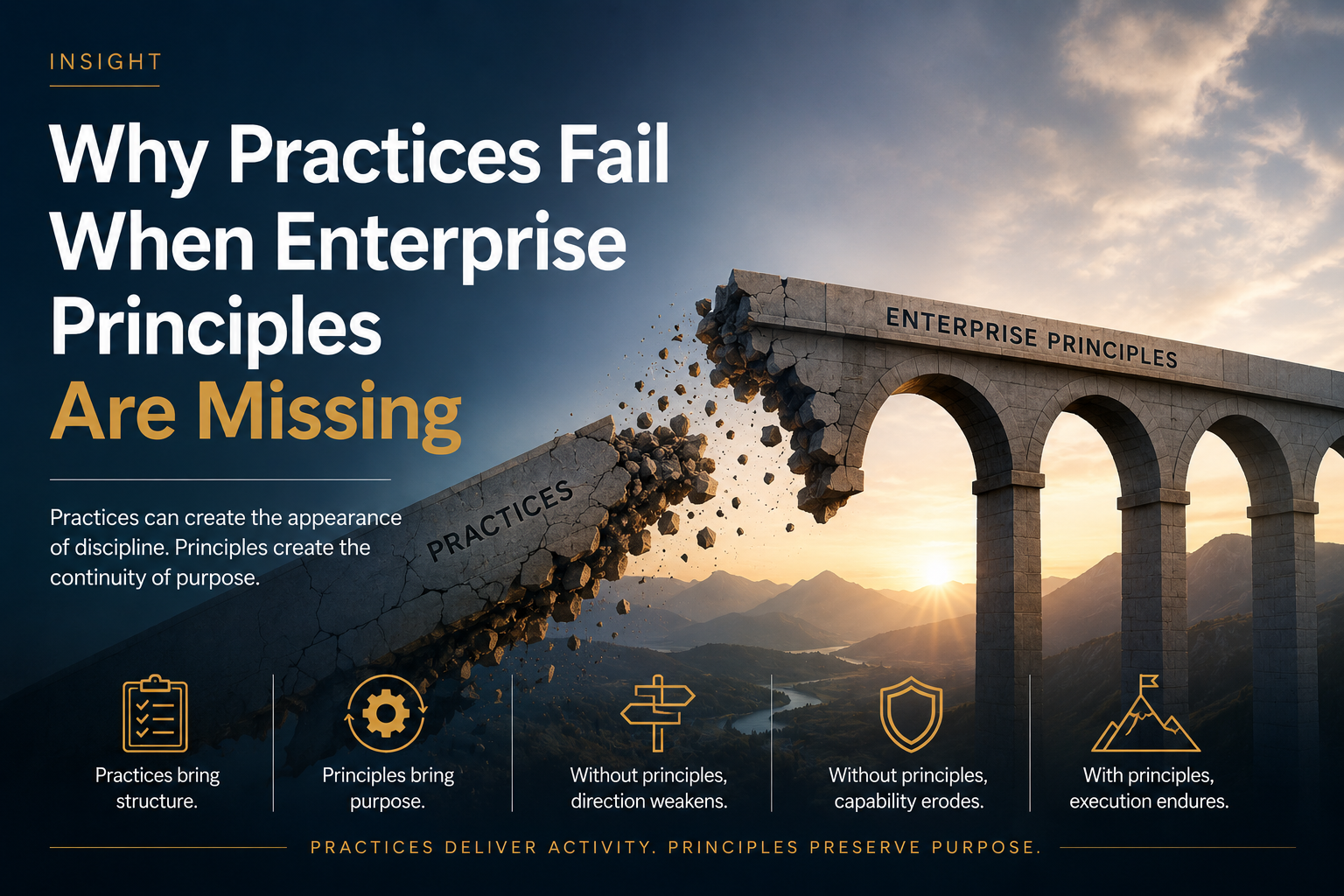
Why Practices Fail When Enterprise Principles Are Missing
Organizations have never had greater access to proven practices.
Yet access to proven practices has not translated into consistently proven outcomes.
Organizations invest heavily in governance models, Agile ways of working, portfolio management, leadership development, innovation frameworks, and transformation methodologies. Entire industries have emerged around defining, refining, certifying, and scaling these practices.
Yet one question continues to surface across organizations of every size and industry.
Why do practices that consistently succeed in one organization struggle to produce the same outcomes in another?
The explanation is often sought within the practice itself.
Was the framework implemented incorrectly?
Was adoption incomplete?
Did leadership fail to provide sufficient sponsorship?
Did teams resist the change?
These are reasonable questions.
But they all begin with the same assumption—
that the practice is the primary determinant of success.
What if that assumption is incomplete?
What if the practice is not the problem?
What if the real difference lies in the enterprise conditions within which the practice operates?
That possibility deserves closer examination.
The Practice Paradox
When organizations encounter execution challenges, introducing another practice often feels like the logical response.
New governance forums are established.
Planning processes are refined.
Additional reporting is introduced.
Operating models are redesigned.
Transformation methodologies are adopted.
Most of these actions are well intentioned, and many create genuine value. Yet something subtle often happens over time.
The organization becomes increasingly proficient at performing the practice while gradually losing sight of the organizational condition it was originally intended to strengthen.
The practices remain.
The outcomes become increasingly difficult to sustain.
On the surface, the organization appears disciplined.
Meetings are held.
Governance forums convene.
Portfolio reviews occur.
Dashboards are updated.
Transformation programmes continue moving through familiar routines.
To both insiders and outside observers, everything appears to be functioning as intended.
Yet beneath that visible activity, something less obvious begins to weaken: the connection between the practice and the purpose it was originally intended to serve.
Execution does not usually deteriorate because organizations stop performing practices. It deteriorates because practices gradually become disconnected from the conditions that once made them effective.
Practices Are Visible. Principles Are Not.
Practices lend themselves to organizational structure. They can be documented in playbooks, measured through assessments, standardized across teams, audited for compliance, and replicated across the enterprise.
Their visibility creates an understandable illusion of certainty. If the practice is present, it is tempting to assume the capability is present as well.
Enterprise principles operate differently.
They rarely appear as operating procedures, yet they quietly shape how an organization interprets priorities, makes decisions, evaluates trade-offs, and adapts as conditions evolve.
Practices are what organizations implement. Principles are what determine whether those practices continue creating value.
Organizations often invest enormous effort implementing practices while giving comparatively little attention to the enterprise principles those practices were originally intended to reinforce.
When that happens, the practice survives.
The purpose slowly fades.
When Practices Become Detached from Purpose
Every practice begins by serving a purpose.
Daily stand-ups strengthen coordination.
Governance forums improve decision clarity.
Portfolio reviews connect priorities with investment decisions.
Retrospectives encourage learning and adaptation.
None of these practices were created simply to be performed. They were created to strengthen specific organizational conditions. Over time, however, organizations naturally institutionalize successful practices.
Schedules become fixed.
Processes become standardized.
Expectations become familiar.
Eventually, organizations become better at performing the practice than understanding why it exists. The practice gradually becomes the objective rather than the vehicle.
When that happens, organizations often preserve the mechanism while unintentionally weakening the capability it was designed to strengthen.
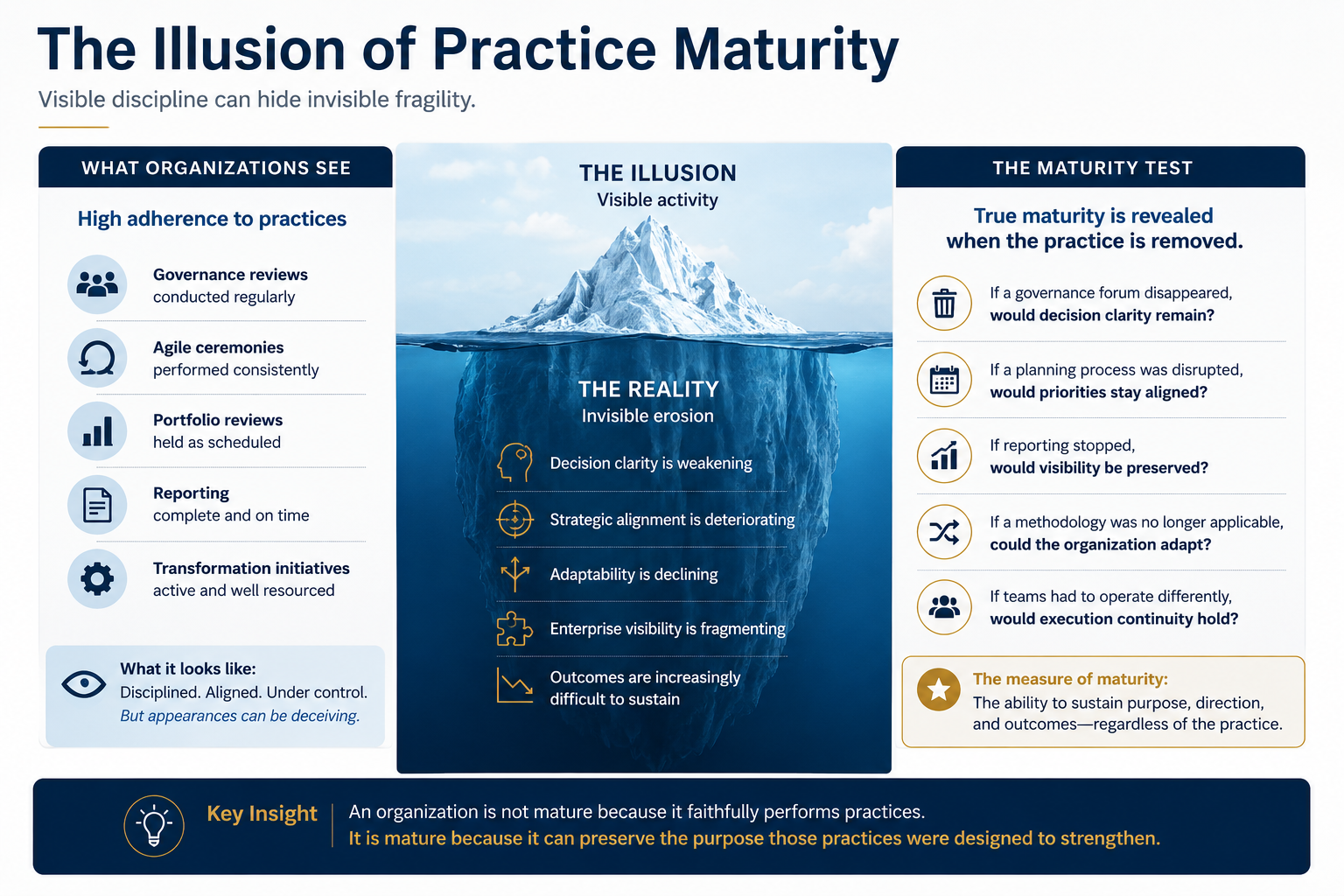
The Illusion of Practice Maturity
Many organizations assume that widespread adoption of practices is evidence of organizational maturity.
This assumption deserves closer examination.
An organization may be highly disciplined in conducting governance reviews while still struggling with decision clarity.
Teams may perform every Agile ceremony while remaining unable to adapt effectively to changing priorities.
Portfolio reviews may occur regularly while strategic alignment continues to weaken.
Reporting may increase while enterprise visibility declines.
In these situations, organizations often respond by introducing additional controls.
Additional reporting.
Additional checkpoints.
Additional oversight.
Yet the underlying issue is frequently not the absence of practice. It is the assumption that organizational maturity is demonstrated through consistent adherence to a practice.
A more difficult question is rarely asked:
What happens when the practice is no longer available?
Suppose a governance forum is removed.
Suppose a planning process is disrupted.
Suppose a reporting structure disappears.
Suppose a familiar methodology is no longer applicable.
Can leaders and teams quickly adapt while maintaining continuity of direction, decision-making, coordination, and outcomes? Or does progress immediately stall until the original practice is restored?
The answer may reveal more about organizational maturity than the practice itself.
A mature enterprise is not one that has mastered a practice.
It is one that understands the purpose the practice was intended to serve and can sustain that purpose even as conditions change.
Practices are valuable because they help reinforce organizational capabilities. But capabilities should not become dependent upon the practices that initially helped establish them. When they do, organizations begin confusing procedural proficiency with enterprise adaptability.
This is the illusion of practice maturity.
Organizations become increasingly confident in the practices they perform while becoming progressively less certain that they can sustain progress when those practices are disrupted, replaced, or no longer appropriate.
The ultimate test of maturity is not whether a practice is followed consistently. It is whether the organization can maintain continuity when the practice itself is no longer available.
If removing a single practice causes execution to falter, decision-making to slow, or coordination to fragment, the organization has not strengthened an enterprise capability—it has become dependent on a mechanism.
Practices should reinforce capability.
They should never become a substitute for it.
Signals That Principles Are Missing
Certain patterns tend to appear when practices become disconnected from the principles that once sustained them.
The absence of enterprise principles rarely announces itself. Instead, it appears through subtle contradictions.
Governance becomes more active while decision clarity becomes harder to achieve.
Reporting becomes richer while enterprise visibility becomes less coherent.
Agile practices become more consistent while adaptability quietly declines.
Transformation initiatives multiply while organizational alignment becomes increasingly fragile.
The organization is not doing less. In many cases, it is doing more than ever. It is simply achieving less from what it continues to do.
A Different Way to Think About Practices
Perhaps practices should not be viewed primarily as solutions.
Perhaps they should be viewed as expressions of the enterprise principles they are intended to reinforce.
A governance forum is not valuable simply because it exists. A planning process is not valuable simply because it is followed. A methodology is not valuable simply because it is adopted.
Their value emerges from the conditions they strengthen and sustain. When those conditions weaken, practices often continue operating while their effectiveness gradually declines.
Organizations rarely struggle because practices are absent.
They struggle when practices become disconnected from the enterprise principles that give them coherence, meaning, and continuity. Perhaps the next measure of enterprise maturity is not how faithfully practices are performed. It is how confidently leaders can remove one without losing continuity.
Because practices should reinforce capability.
They should never become a substitute for it.
Enterprise principles enable organizations to preserve purpose even as practices, technologies, structures, and operating environments continue to evolve.
Enterprise Principles do not produce outcomes on their own. They become meaningful only when consistently translated into execution.