
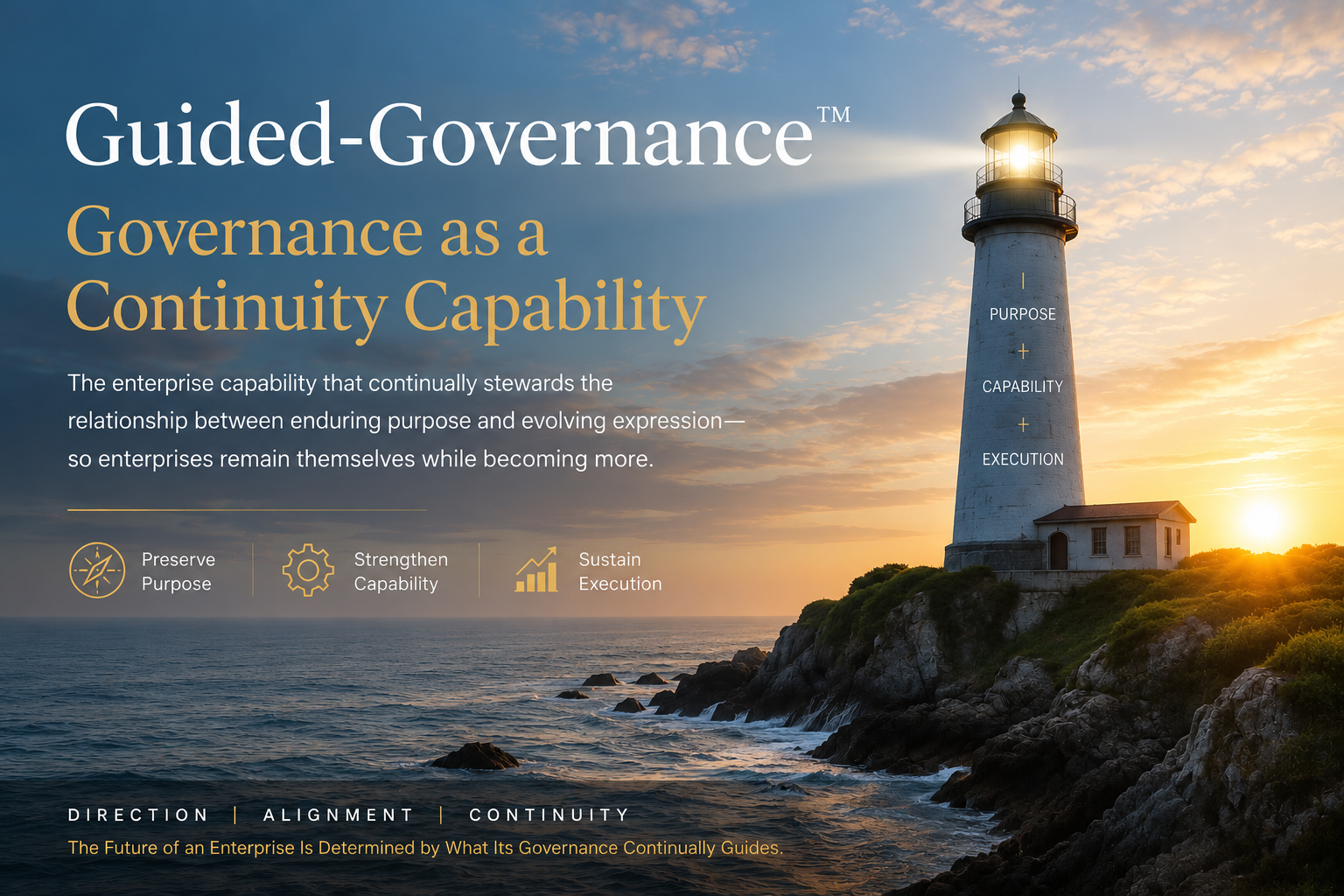
Guided-Governance™: Governance as a Continuity Capability
Guided-Governance™: Governance as a Continuity Capability. © Synergetic Agility Inc.
If every enterprise must preserve its purpose while continually strengthening the capabilities that changing conditions require, what enterprise capability makes that continuity possible?
The answer is not more governance.
Nor is it better governance mechanisms.
It is Guided-Governance™—the enterprise capability that continually preserves coherence between enduring purpose and its evolving realization.
Most enterprises already govern. They establish policies, decision rights, and oversight mechanisms. These are indispensable to organizational discipline.
Yet governance alone does not explain why some enterprises continually preserve their purpose through changing conditions while others gradually drift despite appearing well governed.
The difference lies not in whether governance exists, but in what governance continually stewards.
Guided-Governance™ begins with a different understanding.
Governance is not fundamentally about exercising control, enforcing compliance, or preserving organizational structures. Its enduring responsibility is to continually steward enterprise purpose as conditions evolve.
What Do We Mean by Enterprise Purpose?
Before considering what governance stewards, we must first understand what it is stewarding.
The word purpose is often interpreted in different ways. Some associate it with a mission statement, strategic objectives, public mandate, or organizational priorities.
Guided-Governance™ uses the term more fundamentally.
An enterprise exists for a reason that extends beyond its organizational structure, operating model, or current strategy. That enduring reason explains why the enterprise should continue to exist and why society, customers, citizens, or stakeholders continue to place their trust in it.
This is its enterprise purpose.
Purpose should endure — its expression must continually evolve.
An enterprise that merely survives while no longer fulfilling the reason for which it exists has preserved the organization but lost the enterprise.
This distinction matters.
Organizations are institutional expressions. They possess structures, processes, governance mechanisms, and legal identities.
An enterprise is something different. It is the continuing realization of an enduring purpose through continually strengthened capability and disciplined execution.
Guided-Governance™ therefore concerns itself not simply with preserving organizations, but with preserving enterprises.
That responsibility introduces a second, inseparable idea.
Purpose explains why the enterprise exists.
Continuity requires the enterprise to continually strengthen itself so it remains capable of fulfilling that purpose despite changing conditions.
Guided-Governance™ continually stewards enduring purpose, enterprise capability, and disciplined execution as enterprise conditions evolve.
Only when purpose and continuity remain inseparable can governance genuinely preserve the enterprise rather than merely maintaining the organization.
Governance Exists to Steward Purpose
Guided-Governance™ addresses enterprise governance. The governance of portfolios, programs, projects, technology, data, risk, finance, and other domains are specialized expressions through which that stewardship is realized.
Once enterprise purpose is understood as the enduring reason an enterprise exists, governance can be understood more clearly.
Governance is often described in terms of what it does. It establishes
decision rights,
allocates authority,
ensures compliance, and
provides oversight.
These responsibilities are indispensable to the effective operation of every enterprise.
Yet none of them explains why governance exists. They describe governance's expressions — not its purpose.
The more fundamental responsibility of governance is to continually steward enterprise purpose by ensuring the enterprise remains capable of fulfilling it as conditions evolve.
That distinction changes how governance is understood.
Governance does not exist to preserve policies.
Nor to preserve organizational structures.
Nor to preserve decision-making processes.
Nor simply to enforce compliance.
These are mechanisms through which governance is expressed.
The enduring responsibility of governance is to preserve the enterprise's ability to continue realizing its purpose.
This requires more than maintaining stability.
Markets evolve. Technologies transform industries. Regulatory environments shift.
The conditions under which an enterprise fulfills its purpose continually evolve. Governance therefore cannot merely preserve today's successful organizational and governance expressions.
It must continually determine which expressions should endure, which should evolve, and which should be relinquished in service of the enterprise's enduring purpose.
Seen this way, governance becomes an ongoing act of stewardship rather than a collection of administrative mechanisms.
Its success is measured not by how effectively it preserves itself, but by how effectively it preserves the enterprise's continued ability to fulfill the reason for which it exists.
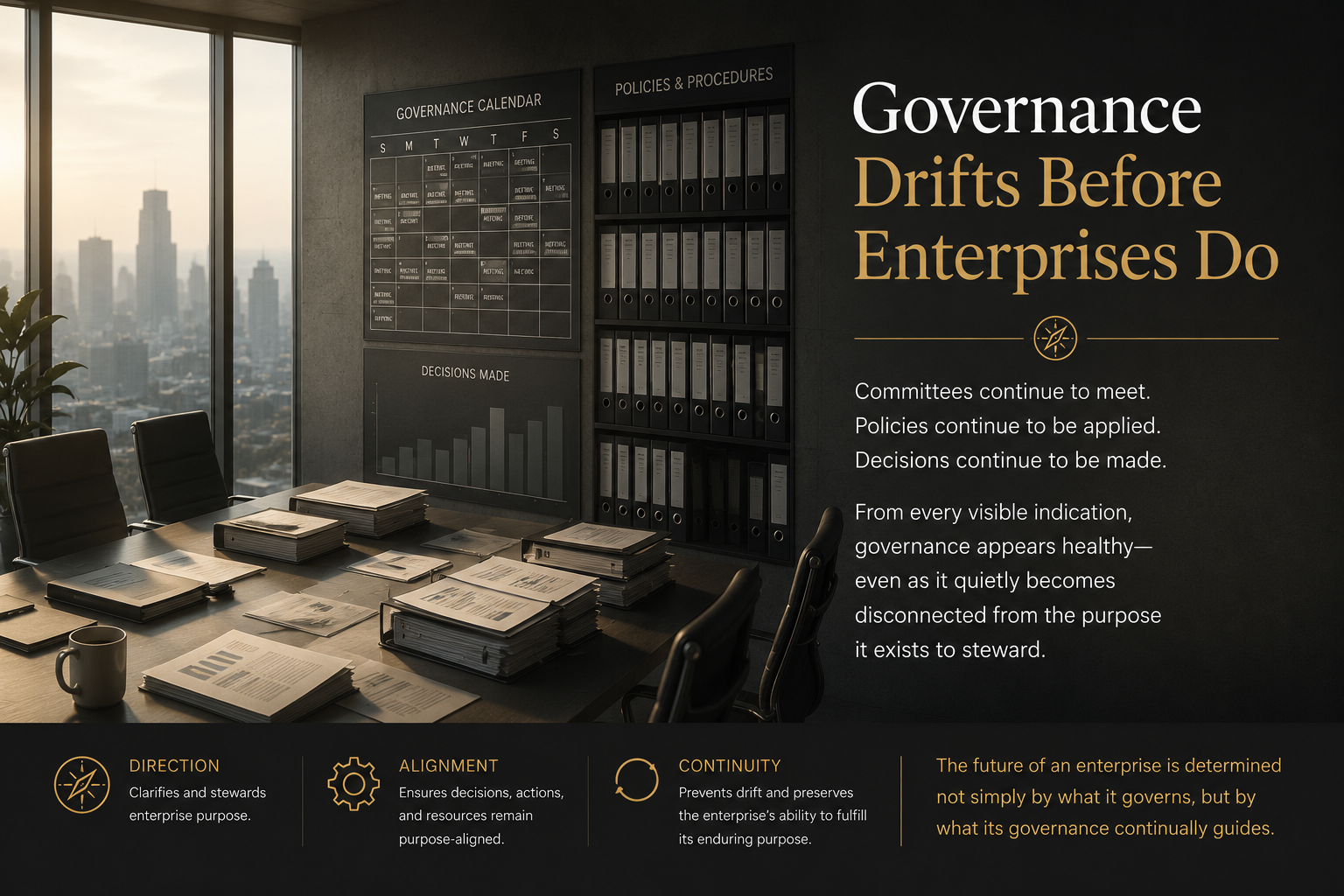
Governance Drifts Before Enterprises Do
Enterprises rarely lose their way through sudden failure. More often, they gradually become separated from the purpose they were established to fulfill.
The same is true of governance. Governance seldom disappears.
Committees continue to meet.
Policies continue to be applied.
Decisions continue to be made.
From every visible indication, governance appears healthy. Yet governance can continue functioning while gradually becoming disconnected from the enterprise purpose it exists to steward.
This is governance drift.
Governance drift does not occur because governance stops. It occurs because governance gradually becomes more attentive to preserving its existing expressions than continually stewarding the enterprise through changing conditions.
The mechanisms themselves are not the cause of governance drift. Indeed, they are indispensable expressions of governance. The challenge arises when governance gradually becomes identified with the mechanisms through which it is expressed.
As governance matures, its expressions become institutionalized.
Structures are established.
Decision authorities are defined.
Policies are documented.
Roles are assigned.
People become responsible for practicing, maintaining, strengthening, and protecting these mechanisms.
This institutionalization is both necessary and desirable. It enables governance to be practiced consistently across the enterprise. Yet it also introduces a subtle consequence.
Unless these mechanisms are continually revitalized in service of enterprise stewardship, they naturally begin reinforcing themselves.
The structures reinforce the mechanisms.
The mechanisms reinforce the structures.
Those entrusted with governance faithfully fulfill their responsibilities by protecting and improving the governance system they have inherited.
Nothing appears broken.
Governance becomes increasingly disciplined — increasingly consistent — increasingly mature.
From every visible indication, governance appears stronger.
Policies become more comprehensive.
Controls become more rigorous.
Approval pathways become more structured.
Oversight becomes more frequent.
Compliance measures expand.
Reporting becomes increasingly sophisticated.
Committees meet with greater regularity.
Decision-making appears more disciplined.
Yet these are not, in themselves, evidence that governance is continually stewarding the enterprise. They are evidence that governance mechanisms are becoming more established. There is another reason governance drift develops so quietly.
Governance is ultimately practiced through people.
Mechanisms define responsibilities — Responsibilities shape behaviours — Behaviours gradually establish organizational norms.
Over time, those entrusted with governance naturally become responsible for sustaining the mechanisms they inherit.
They refine them. Strengthen them. Protect them. Teach others to apply them consistently.
This is neither resistance nor neglect. It is responsible stewardship of the governance system as it is understood.
Yet when enterprise governance is no longer continually interpreted in light of the enterprise's enduring purpose, those same behaviours gradually begin reinforcing established expressions rather than continually renewing the stewardship they were intended to serve.
Interpretations become normalized — Normalized interpretations become accepted practice — Accepted practice gradually becomes governance itself.
Without realizing it, the enterprise begins championing the expressions of governance rather than the stewardship from which those expressions originally emerged.
Interpretation is inevitable. Changing conditions continually require enterprises to reinterpret how enduring purpose should be realized.
Drift is not.
Drift begins when governance repeatedly reinforces yesterday's successful interpretations until they quietly become today's unquestioned assumptions. Stability gradually becomes confused with continuity.
The enterprise seldom experiences this as a sudden failure. It experiences it as a gradual narrowing of interpretation.
Questions become less exploratory.
Exceptions become less tolerated.
Governance discussions increasingly focus on adherence rather than appropriateness.
Structures become easier to defend than to reconsider.
Only much later does the enterprise recognize that governance has continued uninterrupted while its stewardship has quietly diminished.
By the time enterprise drift becomes visible, governance drift has often been underway for far longer.
Governance Drifts Before Enterprises Do. © Synergetic Agility Inc.
Guided-Governance™—The Enterprise Capability
If governance exists to continually steward enterprise purpose, and governance drift occurs when that stewardship gradually becomes separated from changing enterprise conditions, then the enterprise requires something more fundamental than additional governance mechanisms.
It requires the enterprise capability to continually steward purpose, capability, and execution as conditions evolve.
This is Guided-Governance™.
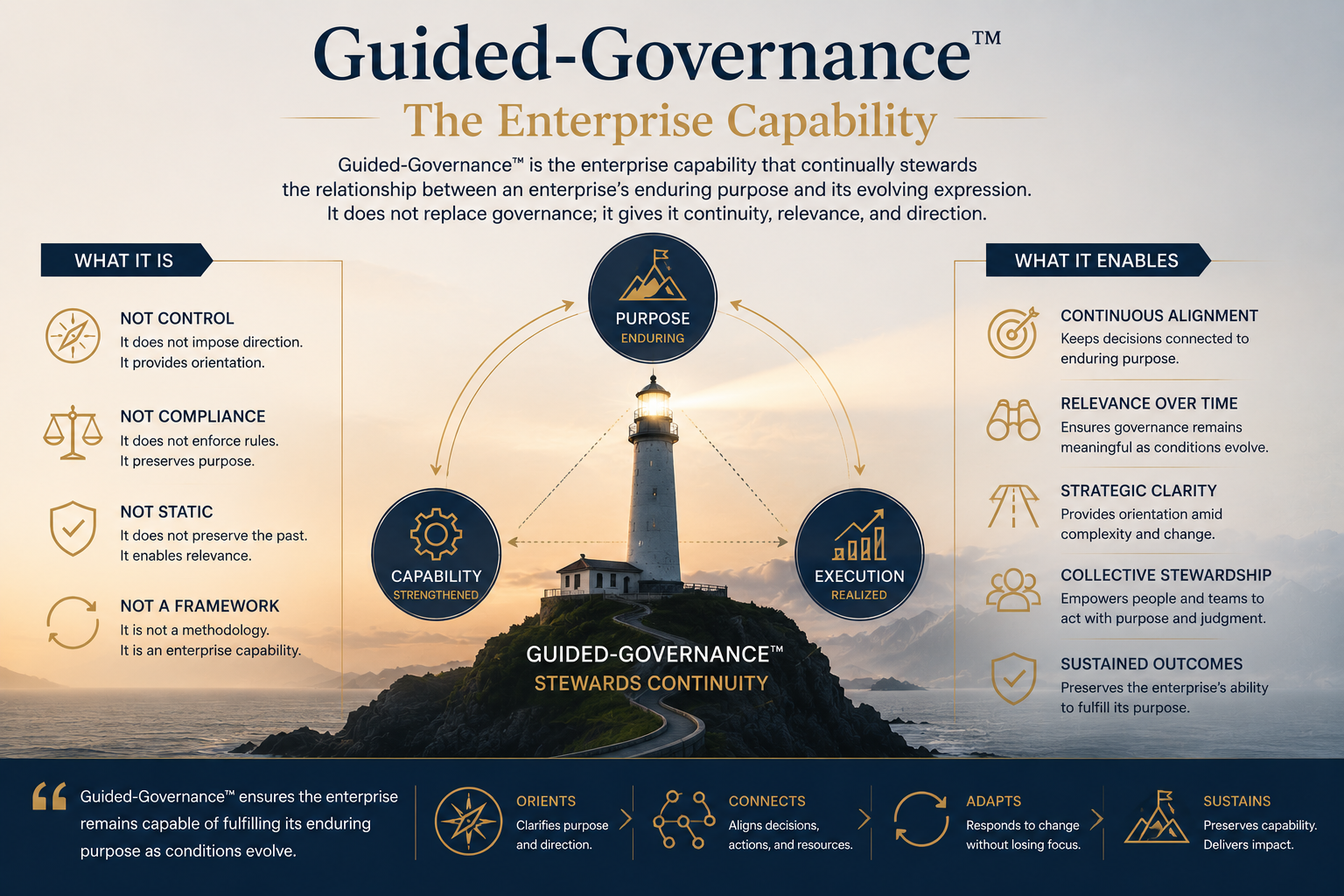
Guided-Governance™ is the enterprise capability that continually stewards enduring purpose, enterprise capability, and disciplined execution as enterprise conditions evolve.
It does not replace governance. Nor does it compete with established governance models, frameworks, methodologies, or operating practices.
Rather, it continually guides how governance itself remains connected to the enterprise it exists to steward.
This distinction is important.
Frameworks prescribe practices.
Methodologies organize activities.
Operating models coordinate responsibilities.
Governance mechanisms establish authority, accountability, oversight, and decision-making.
Each contributes valuable structure to enterprise operation.
Yet none of them, by themselves, continually determines whether the enterprise is strengthening the capabilities that changing conditions now require in order to preserve its enduring purpose. That responsibility belongs to Guided-Governance™.
Because Guided-Governance™ is a capability, it is continually exercised rather than implemented.
It cannot be deployed once and considered complete. It cannot be institutionalized and left unchanged. Its effectiveness depends upon continual interpretation, continual learning, and continual stewardship.
As enterprise conditions evolve, Guided-Governance™ continually realigns purpose, capability, and execution.
Rather than asking whether governance is functioning correctly, Guided-Governance™ continually asks a different question:
Is governance still strengthening the enterprise's continuing ability to fulfill its enduring purpose?
That question changes everything.
It shifts governance from preserving established expressions to continually preserving enterprise continuity. In doing so, Guided-Governance™ becomes not another governance framework, but the enterprise capability that continually renews governance itself.
Guided-Governance™—The Enterprise Capability. © Synergetic Agility Inc.
Renewal Without Reinvention
The continual stewardship of enterprise purpose does not require governance to be continually reinvented. It requires governance to be continually renewed. There is an important difference.
Reinvention suggests abandoning what already exists in pursuit of something entirely new. Renewal preserves what continues to serve the enterprise while deliberately evolving what changing conditions now require.
Enterprises rarely succeed because they repeatedly replace their governance systems. They succeed because they continually strengthen the enterprise's ability to fulfill its enduring purpose without losing the coherence that already exists.
Guided-Governance™ therefore does not encourage perpetual change. Nor does it seek continual stability. It seeks continual relevance.
Some governance expressions remain appropriate for decades. Others require refinement. Still others must eventually be relinquished because they no longer strengthen the enterprise they were created to serve.
The responsibility of Guided-Governance™ is not to decide that everything must change. Its responsibility is to continually discern what should endure, what should evolve, and what should be allowed to conclude.
This is why enterprise continuity depends upon renewal rather than reinvention.
Purpose remains enduring.
Stewardship remains continual.
Capabilities are progressively strengthened.
Governance expressions evolve only as necessary.
Execution becomes increasingly coherent.
The enterprise therefore moves forward without becoming disconnected from the reason it exists.
Renewal is not evidence that yesterday was wrong. It is evidence that stewardship continues.
Through continual renewal, governance remains connected to enterprise purpose, capability continues strengthening, and execution continues realizing what the enterprise exists to achieve.
That is how continuity is preserved—not by repeatedly rebuilding the enterprise, but by continually renewing its capacity to fulfill its enduring purpose.
Guided-Governance™ Stewards Purpose, Capability, and Execution
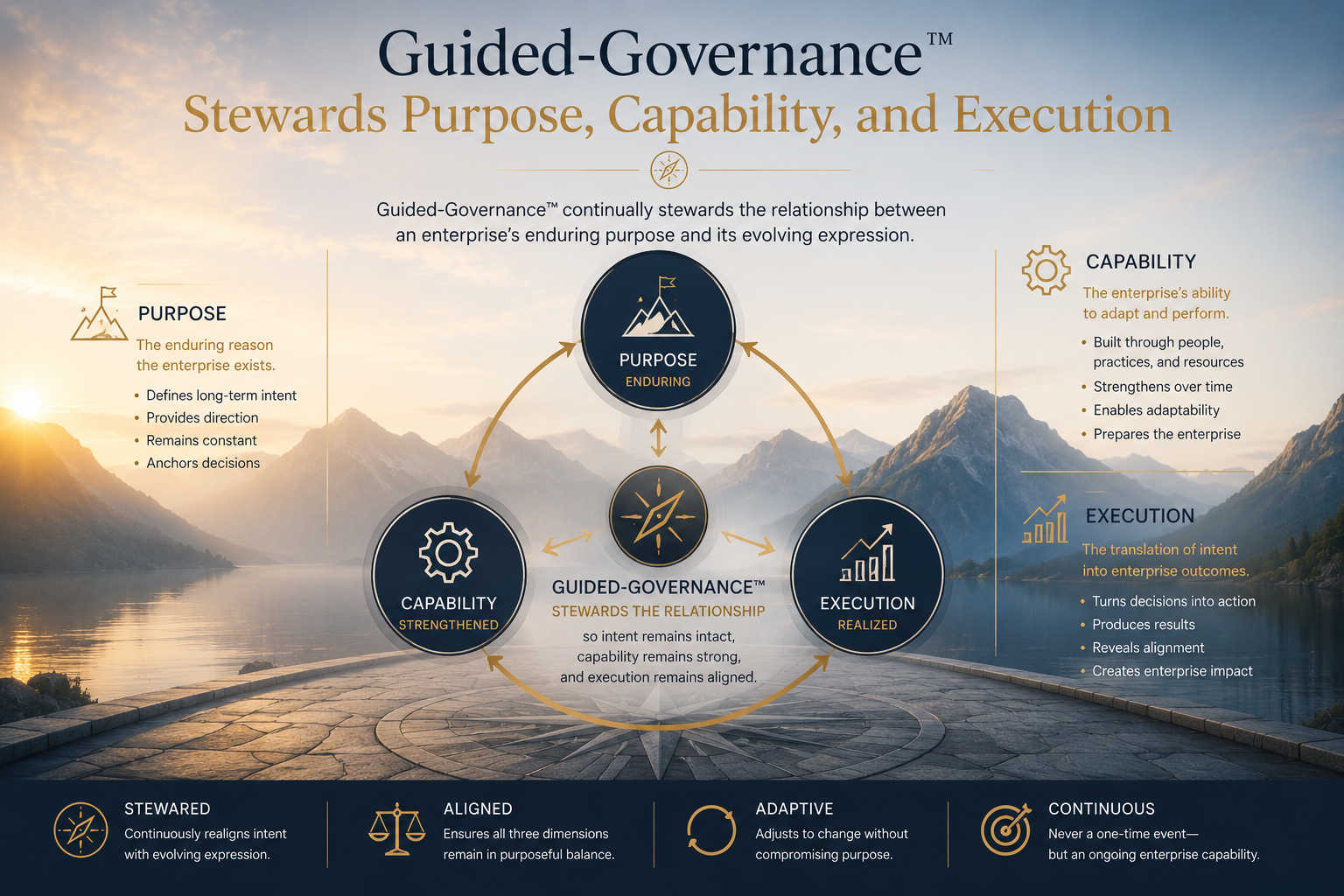
Guided-Governance™ does not steward governance as an end in itself. It continually stewards enduring purpose, enterprise capability, and disciplined execution. It does so as enterprise conditions continually evolve. These are not independent concerns. They are inseparable dimensions of enterprise continuity.
Purpose explains why the enterprise exists.
Capability determines whether the enterprise remains able to fulfill that purpose.
Execution realizes that purpose through coherent and coordinated action.
When these remain continually aligned, the enterprise strengthens itself while remaining faithful to the reason it exists.
When they gradually become separated, governance may continue, capabilities may continue developing, and execution may continue producing results, yet the enterprise itself begins to drift.
This is why Guided-Governance™ cannot concern itself with governance mechanisms alone.
Governance expresses stewardship.
Capability provides capacity.
Execution provides realization.
Each depends upon the others.
Governance that is disconnected from capability gradually preserves structures that no longer strengthen the enterprise.
Capability that is disconnected from purpose risks strengthening capacities that are no longer strategically relevant.
Execution that is disconnected from either may continue delivering successful initiatives without advancing the enterprise's enduring purpose.
Guided-Governance™ continually realigns purpose, capability, and execution.
It continually asks:
Does our purpose remain clearly understood?
Are we strengthening the capabilities that changing conditions now require?
Is our execution continually realizing that purpose through those strengthened capabilities?
These are not separate questions. They are different expressions of the same responsibility: preserving enterprise continuity.
Through this continual stewardship, Guided-Governance™ enables the enterprise to evolve without losing coherence.
Purpose remains enduring.
Governance remains intentional.
Capabilities remain relevant.
Execution remains disciplined.
Together, they enable the enterprise not merely to endure changing conditions, but to continually strengthen its ability to fulfill the reason it exists.
Guided-Governance™ Stewards Purpose, Capability, and Execution. © Synergetic Agility Inc.
Recognizing Guided-Governance™
Guided-Governance™ is not recognized by the number of governance mechanisms an enterprise establishes. Nor is it measured by the quantity of policies, committees, controls, reporting structures, or oversight activities it maintains. These are important expressions of governance.
They are not, by themselves, evidence of Guided-Governance™. Guided-Governance™ becomes recognizable through the quality of the enterprise's continual stewardship. Purpose remains consistently understood, even as its expression evolves.
Governance continually realigns its decisions to that enduring purpose rather than merely preserving established practices.
Capabilities are strengthened because changing conditions require them, not simply because they have become fashionable or technologically possible.
Execution consistently advances enterprise purpose rather than merely completing initiatives or achieving operational targets.
These are not isolated successes.
Together, they reflect an enterprise that continually preserves coherence between why it exists, how it strengthens itself, and what it ultimately accomplishes.
Recognition also comes from the questions the enterprise continually asks itself.
Not:
"Are we following our governance processes?"
But:
"Are our governance processes still strengthening the enterprise's ability to fulfill its enduring purpose?"
Not:
"Are we successfully delivering initiatives?"
But:
"Are those initiatives continually strengthening the capabilities our changing enterprise now requires?"
Not:
"Have we preserved organizational stability?"
But:
"Have we preserved enterprise continuity?"
These questions do not replace governance. They continually renew it.
An enterprise practicing Guided-Governance™ therefore exhibits a distinctive characteristic.
Governance is neither static nor reactive.
Capability development is neither opportunistic nor disconnected.
Execution is neither activity for its own sake nor merely operational efficiency.
Each continually reinforces the others through a shared commitment to preserving enterprise continuity.
Guided-Governance™ may not always be immediately visible. Its greatest contribution is often recognized only over time.
Enterprises continue adapting without losing coherence.
Governance evolves without losing stewardship.
Capabilities strengthen without losing relevance.
Execution advances without losing purpose.
That quiet continuity is the strongest evidence that
Guided-Governance™ is present.
Conclusion
Every enterprise is entrusted with an enduring purpose. That purpose explains why the enterprise exists. Yet purpose alone does not preserve the enterprise.
The enterprise must continually strengthen the capabilities required to fulfill that purpose as conditions evolve. Governance exists to steward that responsibility.
But governance itself is not immune to drift.
As governance becomes increasingly institutionalized, its expressions can gradually become separated from the enterprise they were established to serve. The result is seldom immediate failure.
It is the quiet erosion of stewardship while governance continues appearing healthy.
Guided-Governance™ addresses that challenge.
Not by replacing governance. But by continually renewing the stewardship that keeps governance, capability, and execution connected to the enterprise's enduring purpose.
In doing so, Guided-Governance™ enables enterprises to preserve continuity without resisting change. To strengthen capability without pursuing change for its own sake. And to execute with discipline without becoming disconnected from the reason the enterprise exists.
The question, therefore, is not whether governance exists.
Most enterprises already govern. The more fundamental question is whether governance continues guiding the enterprise toward the enduring purpose it exists to fulfill.
Because enterprises rarely become something different overnight. They gradually become the consequence of what they continually strengthen.
The future of an enterprise is therefore determined not simply by what it governs, but by what its governance continually guides.