
Guided-Governance™
What does Guided-Governance™ mean?
Guided-Governance™ establishes governance continuity so priorities, decisions, execution practices, and value realization remain coherently connected as conditions evolve.
Strengthening Governance Continuity Across Evolving Enterprise Priorities
Guided-Governance™ strengthens how organizations sustain governance continuity as priorities, leadership conditions, and enterprise realities evolve.
As a foundational execution principle within the Execution Architecture™, it reinforces how direction, decision clarity, and organizational alignment remain connected across interconnected enterprise environments.
The focus remains on governance as a shaping condition for coherent enterprise execution rather than as a disconnected oversight structure.
Why Guided-Governance™ Matters
Organizations rarely struggle because governance is absent.
Challenges emerge when:
priorities evolve without clear direction,
decision-making becomes fragmented,
governance loses continuity across interconnected initiatives,
visibility weakens across enterprise environments,
and organizational efforts advance without sustained alignment.
These conditions gradually reduce:
organizational coherence,
leadership confidence,
enterprise visibility,
directional continuity,
and sustained organizational alignment.
Guided-Governance™ strengthens the conditions through which organizations sustain clearer direction, governance continuity, and aligned enterprise progression across evolving priorities.
What Guided-Governance™ Strengthens
Guided-Governance™ reinforces governance as a shaping condition for aligned enterprise direction.
It strengthens:
decision clarity,
governance continuity,
enterprise visibility,
organizational alignment,
directional continuity,
and sustained organizational coherence.
In Practice
Guided-Governance™ integrates with existing enterprise environments rather than introducing parallel governance structures.
In practice, it strengthens:
directional clarity across interconnected priorities,
governance continuity across transformation efforts,
visibility across enterprise environments,
alignment across leadership conditions,
and sustained organizational coherence.
This enables governance to reinforce aligned enterprise direction as priorities and organizational conditions continue to evolve.
The Role of Guided-Governance™ within Execution Architecture™
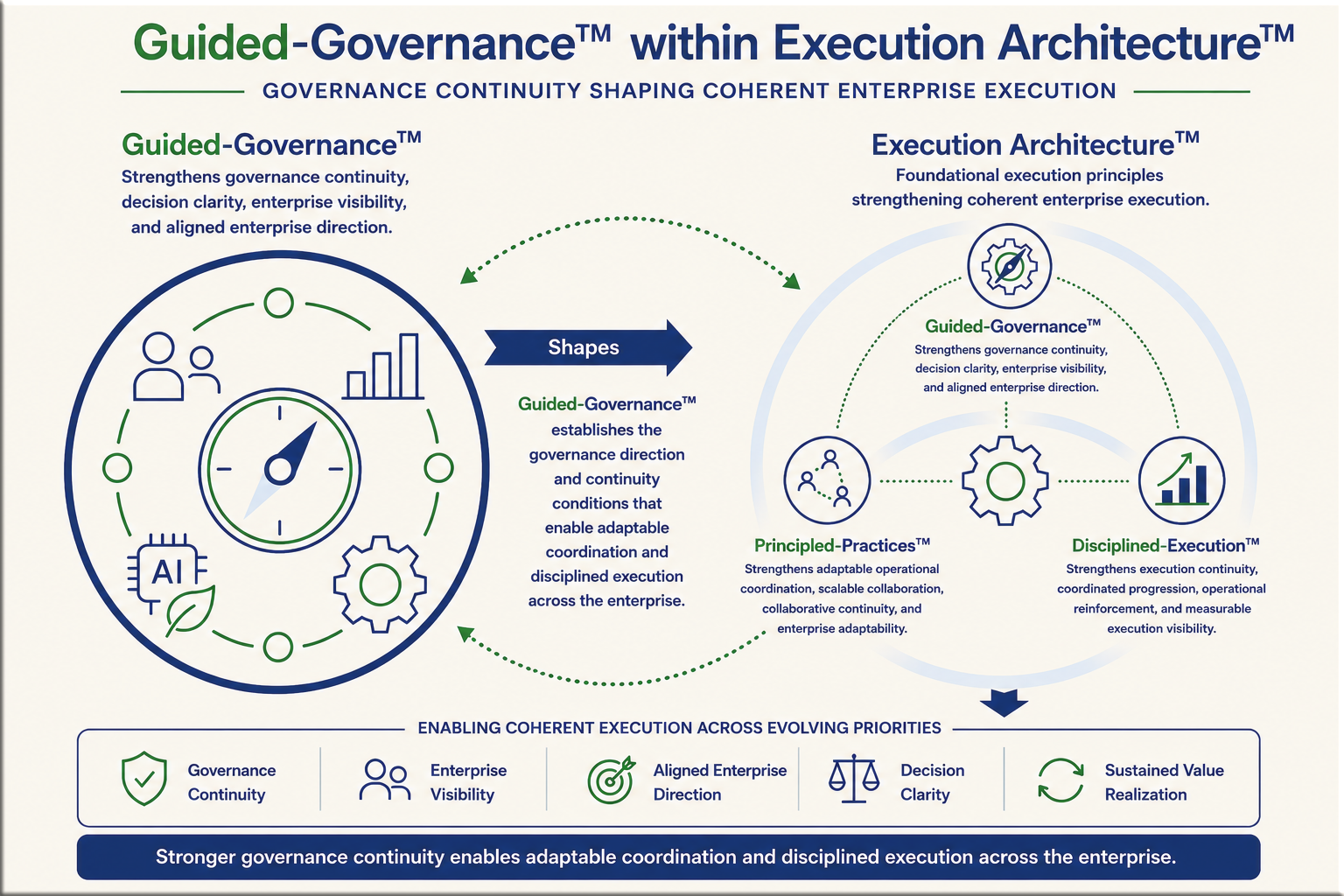
Guided-Governance™ operates as one of the foundational execution principles within the Execution Architecture™.
It reinforces the governance continuity through which:
enterprise direction remains aligned,
priorities sustain continuity,
organizational visibility remains connected,
and enterprise progression remains coherent across evolving conditions.
Together with Principled-Practices™ and Disciplined-Execution™, it strengthens coherent enterprise execution across interconnected enterprise environments.
Execution Contexts Where Guided-Governance™ Applies
Guided-Governance™ becomes organizationally visible across contexts such as:
enterprise transformation initiatives,
governance and alignment environments,
leadership stewardship initiatives,
AI-enabled and ESG-aligned enterprise priorities,
enterprise-wide change efforts,
and interconnected organizational ecosystems.
These contexts represent environments where governance continuity reinforces aligned enterprise direction.
Outcomes Strengthened Through Guided-Governance™
Organizations strengthening governance continuity across evolving priorities improve:
organizational alignment,
leadership cohesion,
enterprise visibility,
directional continuity,
governance clarity,
and sustained value realization.
These outcomes emerge through connected governance conditions rather than isolated oversight activity.

Guided-Governance™ strengthens how organizations sustain governance continuity through decision clarity, aligned enterprise direction, organizational visibility, and directional coherence across evolving priorities.
Together, these conditions support organizational alignment, leadership continuity, governance clarity, and sustained value realization across interconnected enterprise environments.